
healthStay for Enterprise Hospitals
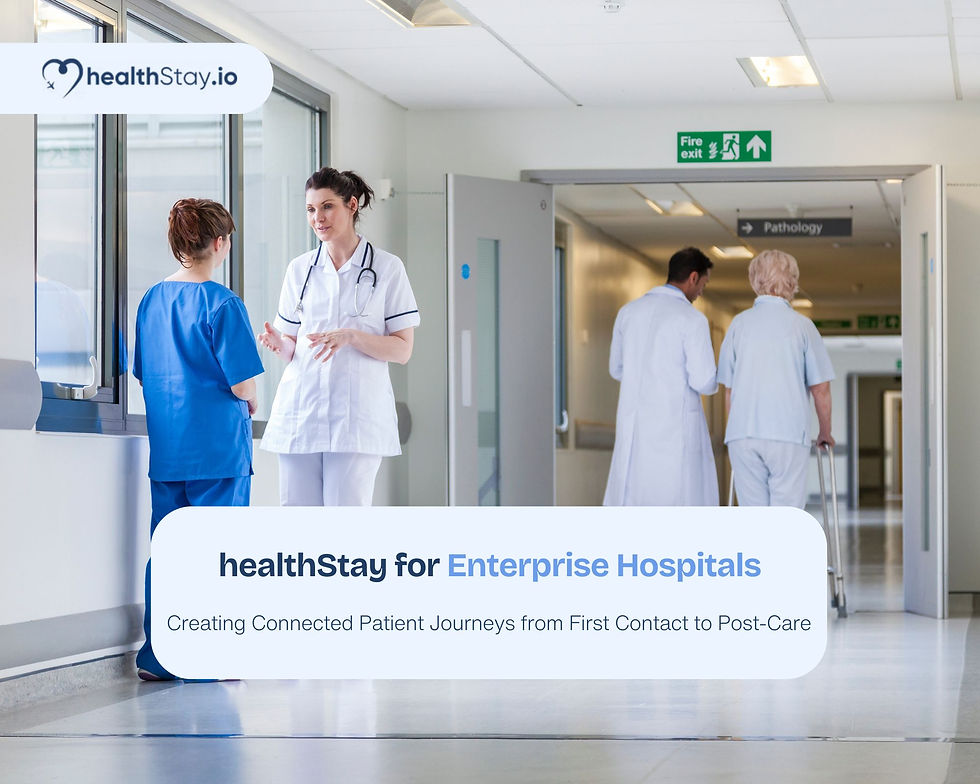
🌐 Creating Connected Patient Journeys from First Contact to Post-Care
Enterprise hospitals invest heavily in technology. Electronic health records, patient administration systems, scheduling platforms, laboratory software, radiology systems, and departmental applications all play an essential role in delivering patient care.
Yet despite these investments, the beginning of the patient journey often remains fragmented.
Patient enquiries can arrive through a hospital website, email, WhatsApp, a call centre, referring physicians, embassies, insurers, medical facilitators, or marketing campaigns. Each channel may follow a different process, involve different teams, and record information in different systems.
The challenge is rarely a lack of technology. It's the absence of a connected operational workflow that guides every patient from their initial enquiry through to treatment and post-care.
healthStay provides that missing operational layer.
🚪 Patient Referrals Don't Arrive Through One Door
Modern hospitals manage enquiries from multiple sources every day.
Patients may contact the hospital directly, while others are referred by physicians, corporate partners, insurers, government organisations, embassies, or international patient programmes.
Once those referrals enter the hospital, they often pass through multiple teams including patient coordinators, call centre agents, nurses, consultants, finance departments, and clinical teams.
Without a centralised workflow, hospitals can struggle to answer important operational questions:
Has the enquiry been acknowledged?
Is any clinical information missing?
Who currently owns the patient journey?
Has the referral been reviewed?
What happens next?
Has the patient received an update?
When these questions cannot be answered quickly, both operational efficiency and the patient experience suffer.
⚠️ Administrative Fragmentation Is More Than an Operational Challenge
Referral management is often viewed as an administrative task, but fragmented workflows can have real clinical consequences.
A referral sent to the wrong department, incomplete medical documentation, or delayed communication can all slow clinical decision making and impact patient care.
The NHS Patient Safety Strategy estimates that errors occur in approximately 2% to 3% of primary care encounters, with around one in every twenty-five involving serious patient harm. Delays in referrals are identified as one of the most common safety risks.
Ireland has also experienced the impact of fragmented referral processes. An investigation by the Office of the Ombudsman found that an outdated referral process contributed to a delayed hospital appointment and delayed cancer diagnosis. Following the case, the hospital introduced an electronic referral system to reduce the risk of referrals being lost.
These examples demonstrate why structured workflows are essential, not just for efficiency, but for patient safety.
📋 Manual Data Entry Creates Hidden Risks
Many hospitals still rely on staff manually transferring information between emails, spreadsheets, patient administration systems, and departmental software.
Every manual handover increases the risk of:
Incorrect patient details
Duplicate records
Missing documentation
Delayed action
Unclear accountability
Manual processes also make governance more difficult.
Hospitals need to know when information was received, who reviewed it, where it was routed, and whether the correct actions were completed.
The Department of Health Abu Dhabi increasingly reflects this need through requirements for digital scheduling, patient tracking, traceable workflows, and responsible AI with appropriate human oversight.
👩⚕️ Let Clinical Teams Focus on Clinical Care
Healthcare professionals should spend their time caring for patients, not managing repetitive administrative work.
Across many hospitals, highly trained nurses and clinicians still spend valuable time searching for information, entering patient details, printing reports, coordinating referrals, and chasing updates across multiple systems.
Research published in Mayo Clinic Proceedings found that physicians can spend between one and two hours on electronic records and administrative work for every hour of direct patient care.
Healthcare should not automate clinical judgement.
It should automate the repetitive processes that prevent clinicians from focusing on patients.
💙 Patients Experience the Same Fragmentation
Operational inefficiencies rarely remain hidden behind the scenes.
Patients experience them through repeated requests for information, unclear communication, delayed updates, and uncertainty about what happens next.
This becomes even more important for international and complex care patients, who may also be coordinating travel, accommodation, visas, insurance, and family support while awaiting treatment.
Patients expect transparency, timely communication, and confidence that their care is progressing.
Delivering that experience starts with creating a connected internal workflow.
🤖 One Connected Workflow from Referral to Post-Care
healthStay creates a single operational layer across the entire patient journey.
Whether an enquiry arrives through a website, WhatsApp, email, call centre, physician, insurer, embassy, or medical facilitator, every patient enters one structured workflow.
Our platform helps hospitals:
Capture every enquiry in one central system
Identify missing documentation
Route referrals to the appropriate teams
Assign ownership and next actions
Connect clinical and administrative departments
Automate reminders and patient updates
Track every stage of the patient journey
Maintain a complete audit trail
Integrate with existing hospital systems rather than replacing them
AI supports the repetitive operational work, while healthcare professionals remain in control of every clinical decision.
📊 From Disconnected Referrals to Patient Orchestration
Healthcare organisations don't need another disconnected system.
They need a connected operational model that ensures every enquiry is acknowledged, every referral has ownership, every delay is visible, and every patient receives clear communication throughout their journey.
In Ireland, more than 210,000 incidents are reported annually through the HSE National Incident Management System. In England, the NHS recorded more than 804,000 patient safety incidents between January and March 2026.
While these incidents have many different causes, they highlight the importance of structured workflows, accountability, and continuous operational improvement across modern healthcare organisations.
🚀 Giving Healthcare Teams More Time to Care
healthStay helps enterprise hospitals organise referral management, connect departments, reduce manual administration, and improve visibility across every patient journey.
For hospitals, this means stronger governance, greater operational intelligence, and more efficient workflows.
For staff, it means less repetitive administration and more time to focus on meaningful clinical work.
For patients, it means better communication, greater transparency, and a more connected healthcare experience from first enquiry through to post-care.
The future of hospital operations isn't another standalone system.
It's one connected patient journey.
📝 Giving Healthcare Teams More Time to Care
Whether you're managing referrals across multiple departments or looking to improve operational visibility, understanding where inefficiencies exist is the first step towards improving patient care.
Take our free 1 Minute Healthcare Operations Quiz to benchmark your current patient management processes and identify opportunities to reduce administrative workload, improve workflow efficiency, and create better patient experiences.

